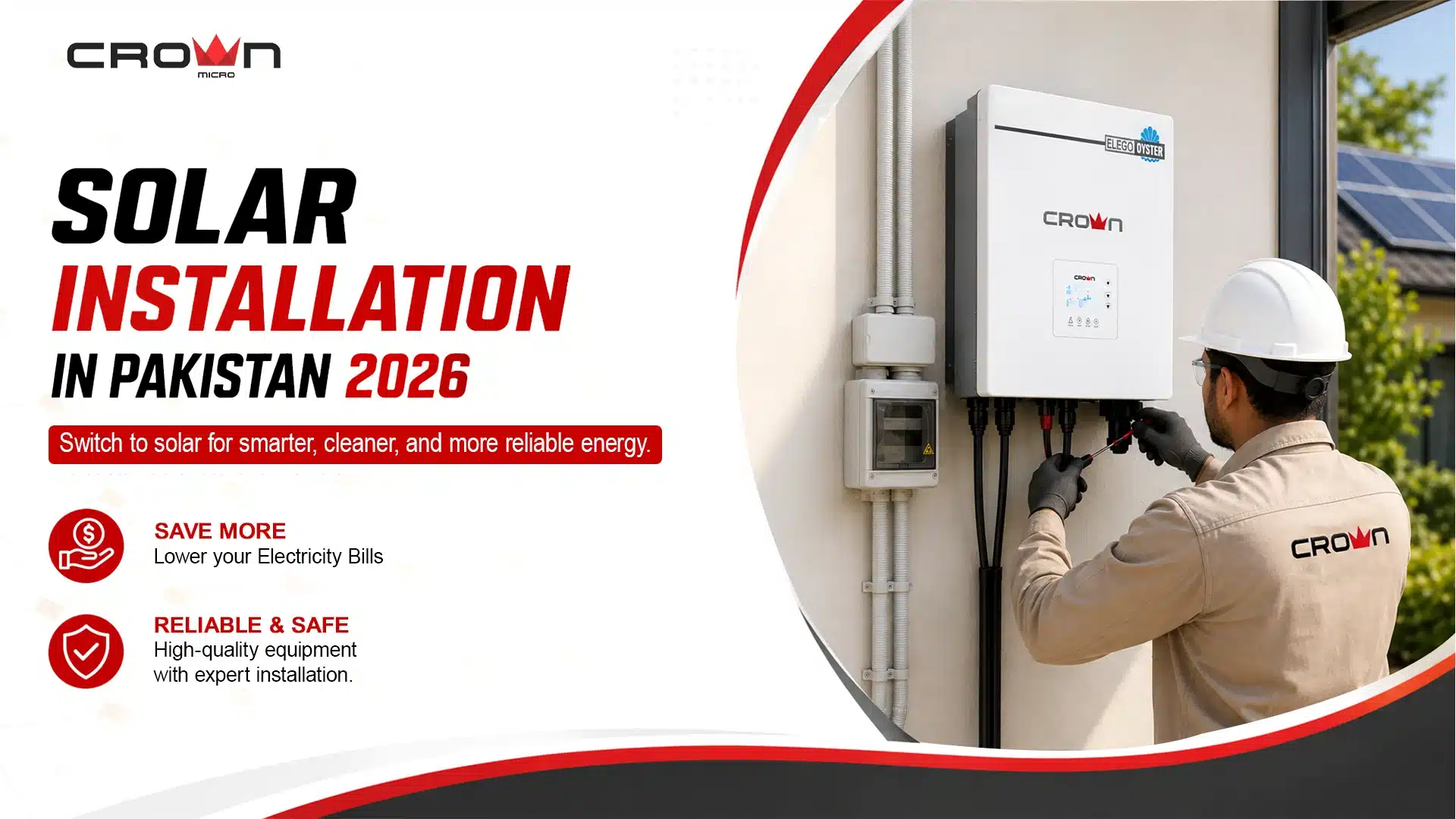
Installing solar in Pakistan in 2026 follows four stages: a site survey to confirm your roof and load, system design and component selection, physical mounting and wiring, and finally net metering registration with your DISCO. A typical residential project takes three to six weeks from survey to grid approval, depending on your city and the complexity of your electrical setup.
Before you call an installer, here is what the process actually involves:
- Site feasibility survey and roof or land assessment
- Load calculation and system sizing (on-grid, off-grid, or hybrid)
- Component selection: panels, inverter, batteries, mounting structure
- Structural mounting and earthquake-rated fixing
- Electrical wiring, protection devices, and inverter commissioning
- Bi-directional meter application through your DISCO
- Final inspection and system activation
Anyone who has dealt with a rushed solar purchase knows the story. A neighbour installs a system, brags about the savings, and within six months, you are chasing the same salesman who cannot answer why your inverter keeps tripping. The solar installation process in Pakistan is not complicated once you understand it in order. It just gets skipped, rushed, or sold to you backwards. This guide walks through it the way it should actually happen, from the first site visit to the day your bi-directional meter starts spinning in your favour.
Phase 1: Pre-Installation and Site Feasibility
Before anyone touches your roof, a proper installer needs to know what they are working with. This phase decides almost everything that follows, including how many panels fit, which direction they face, and whether your existing wiring can handle the extra load.
A feasibility survey covers your average monthly electricity units, your roof’s structural condition, shading from nearby buildings or trees, and the compass orientation of the space. In Lahore and Karachi, south-facing roofs with minimal shading generally produce the best output. Rural and agricultural sites often have more open space but need to account for dust accumulation, which cuts panel efficiency if cleaning schedules are ignored.
Load calculation is where most homeowners get surprised. Your last twelve months of electricity bills tell an installer your real consumption pattern, not just your peak bill. A house that runs air conditioners heavily in summer needs a different system size than one with steady, low year-round usage. Commercial and industrial sites go through the same exercise but with three-phase load data and machinery run-time schedules added in.
Did You Know? A poorly shaded site can lose 15 to 25 percent of expected annual generation even with premium panels installed. Shading analysis is not optional, it is the single biggest reason systems underperform their sales pitch.
Common Mistake: Buying panels first and figuring out sizing later. This backwards approach usually leads to either an oversized system that wastes money under 2026’s reduced buyback rates, or an undersized one that barely dents your bill.
Why a Professional Site Survey Matters
A site survey done properly involves physical roof inspection, not a phone call estimate. The surveyor checks slab thickness, existing reinforcement, parapet height for mounting anchors, and cable routing distance to your main distribution board. For factories and warehouses, this extends to checking whether the roof sheeting can carry the distributed load or needs additional bracing.
It sounds simple until it isn’t. A roof that looks flat and sturdy from the ground can have hairline cracks or insufficient rebar that only show up under close inspection. Skipping this step is how systems end up with sagging structures two monsoons later. Most guides skip this part entirely and jump straight to panel specifications, but the survey is what actually protects your investment before a single wire is run.
Phase 2: Design and Component Selection
Once the survey is done, the design phase turns raw data into a working plan. This is where you decide between an on-grid, off-grid, or hybrid solar installation, and where component quality either sets you up for twenty-five years of reliable output or five years of recurring repair bills.
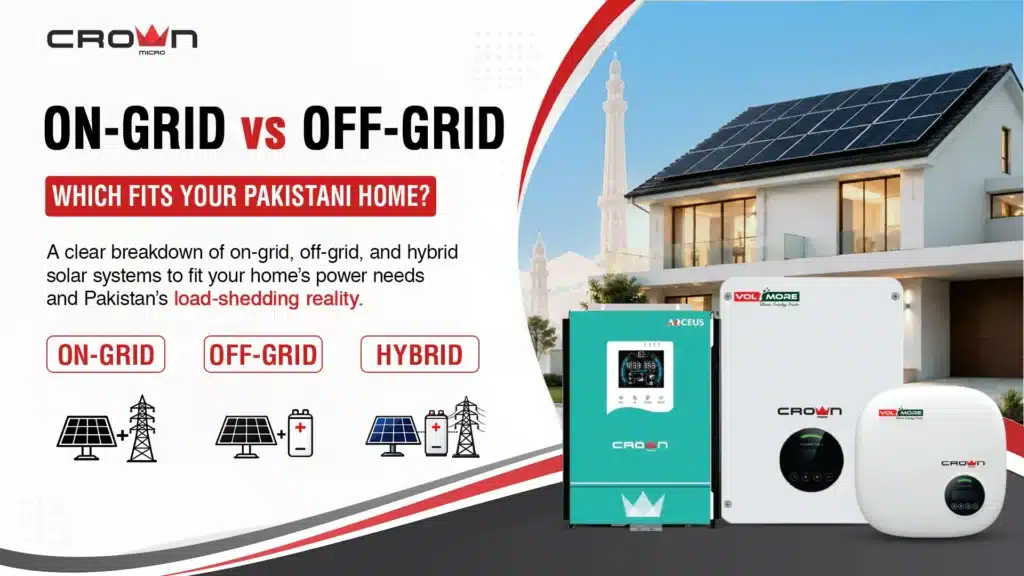
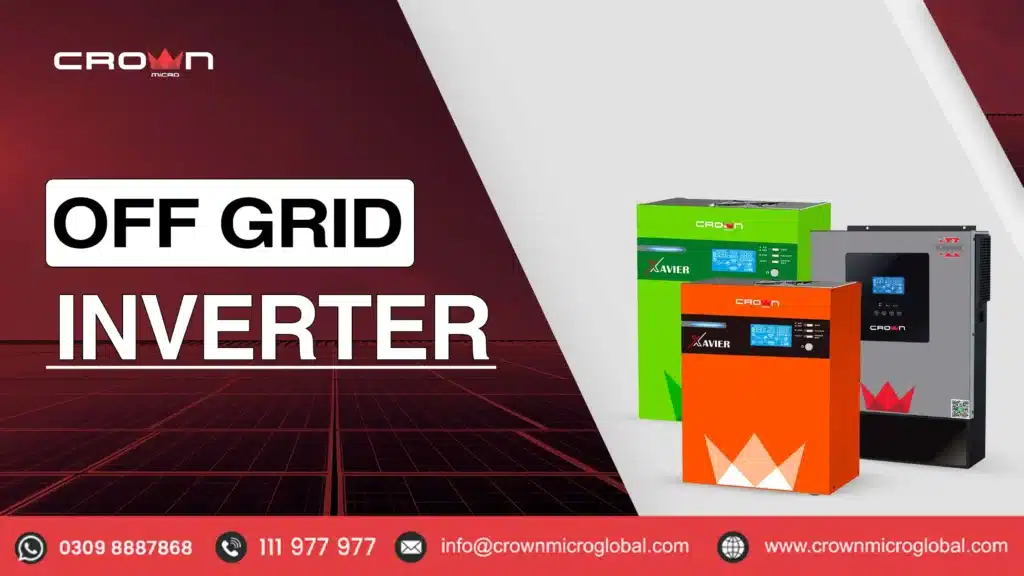
On-grid inverter systems connect directly to the national grid and work best where load-shedding is minimal, since they cannot run without a stable grid reference. Off grid solar inverter rely fully on batteries and suit remote sites, farms, and areas with unreliable grid access. Hybrid solar installation combines both, drawing from solar first, batteries second, and the grid only as a backup. For most urban homes and businesses in 2026, hybrid has become the practical default because it protects against load-shedding while still qualifying for net metering.
Here’s what most people overlook. Inverter sizing is not just about matching your panel wattage. It also depends on your surge load, meaning the momentary spike when motors, compressors, or air conditioners start up. An undersized inverter trips constantly under this kind of load, even if your average consumption looks fine on paper.
| System Type | Best For | Grid Dependency | Battery Required |
|---|---|---|---|
| On-Grid | Urban homes, low load-shedding areas | Fully dependent | No |
| Off-Grid | Farms, remote sites, unreliable grid | None | Yes |
| Hybrid | Homes and businesses with frequent outages | Partial, backup only | Yes (recommended) |
Pro Tip: Ask your installer for the inverter’s certified anti-islanding protection rating before signing anything. This feature, usually IEC 62116, is what your DISCO checks during net metering inspection. Without it, your application gets rejected regardless of how good your panels are.
Choosing 2026 Tier-1 Panels for Pakistan’s Climate
Pakistan’s climate is punishing on solar equipment. Rooftop surface temperatures in Punjab and Sindh regularly exceed 50 degrees Celsius in summer, and panels lose efficiency as heat rises past their rated test conditions. This is why the temperature coefficient listed on a panel’s datasheet matters more here than in cooler climates. A panel with a lower temperature coefficient loses less output as the mercury climbs.
Dust and haze are the other factor most buyers ignore. Industrial belts and agricultural regions accumulate dust fast, and panels without a strong anti-reflective, easy-clean coating degrade in output between cleaning cycles. Tier-1 monocrystalline panels with PERC or TOPCon cell technology currently offer the strongest balance of efficiency and heat tolerance for local conditions. Bifacial panels, which capture reflected light on their rear side, are gaining traction for ground-mount and commercial rooftop projects with light-coloured surfaces underneath.
Warranty terms are worth reading carefully. Most reputable manufacturers now offer 25-year performance warranties guaranteeing panels retain around 80 to 87 percent of original output by year twenty-five. Anything shorter or vaguer than that is a signal to keep comparing.
Phase 3: The Physical Installation Steps
This is the part people picture when they think of a solar installation process, workers on the roof, panels going up, cables being run. It looks straightforward from the ground, but the sequencing and quality of this phase determines how the system performs for the next two decades.
Installation generally follows this order: mounting structure fabrication and fixing, panel placement and racking, DC wiring between panels and combiner boxes, inverter mounting and AC wiring to the distribution board, earthing and lightning protection, and finally commissioning tests before the system is switched on. Each step depends on the one before it, so rushing structural work to hit a deadline almost always shows up later as a wiring or stability problem.
Weather timing matters too. Installers in Pakistan generally avoid mounting work during peak monsoon months if it can be scheduled around, since wet roof surfaces make anchoring and electrical safety harder to manage properly.
Mounting Structure and Earthquake Resistance Standards
The mounting structure is the part nobody thinks about until it fails. Most residential systems in Pakistan use hot-dip galvanized iron or aluminium racking fixed onto RCC slabs, and the thickness of that metal along with the anchor depth decides whether the structure survives a decade of monsoon winds. Monsoon wind speeds in parts of Pakistan reach 80 to 110 km/h, and rooftop temperatures can climb past 50 degrees Celsius, conditions that corrode weak metal and loosen shallow anchors over time.
Structural design in Pakistan is meant to follow the Building Code of Pakistan, including its seismic provisions for earthquake-prone zones and wind load calculations for regional storm exposure. A properly engineered structure accounts for uplift pressure, meaning the force that tries to lift panels off the roof during high wind, not just the downward weight of the panels themselves. Bracket spacing and anchor embedment depth are the two details that separate a structure built to code from one built to look finished.
Pro Tip: Ask for the structure’s steel gauge in writing, not verbally. Thin GI sheeting below roughly 2.5mm often bends or warps within a few years under Pakistan’s heat and wind cycle, even if it looks solid on installation day.
Electrical Wiring and Hybrid Inverter Setup
Wiring is where safety corners get cut most often, usually invisibly. DC wiring between panels must use UV-resistant, solar-rated cable, since ordinary electrical cable degrades quickly under direct rooftop sun exposure. Combiner boxes need proper surge protection devices on both the DC and AC sides, protecting your inverter from the voltage spikes common during Pakistan’s lightning-heavy monsoon storms.
A Crown hybrid inverter setup, for example, is typically configured with programmable supply priority, letting the system decide automatically whether to draw from solar, battery, or grid based on real-time availability. This kind of configuration matters practically. During a summer afternoon with strong sun, the system should be feeding your load directly from panels while topping up batteries, not needlessly pulling from the grid. Getting this priority setting wrong is a common reason people feel like their hybrid system “isn’t saving as much as promised.”
Earthing is the final and most overlooked wiring step. A dedicated earth pit, tested for resistance value, protects both your equipment and anyone touching the system during a fault. Skipping a proper earthing test to save a day of labour is a false economy that shows up the first time there’s an electrical fault on the line.
Phase 4: Net Metering and Grid Connection, the 2026 Rules
This is the phase that changed the most heading into 2026, and it’s worth understanding clearly before you commit to a system size. NEPRA overhauled the country’s net metering regime through the Prosumer Regulations 2026, shifting rooftop solar and other small generators to a new net billing system and repealing the decade-old net metering framework that had run since 2015.
The short answer is yes, net metering still exists, but there’s a catch. Under the new net-billing arrangement, electricity generated by prosumers is purchased by distribution companies at the National Average Energy Purchase Price, while bills for electricity consumed from the grid continue to be raised separately, with the net difference credited or paid at the end of each billing cycle. Utilities purchase excess electricity from prosumers generating up to one megawatt at that rate, while selling electricity back at the applicable consumer tariff, which effectively ends the old one-to-one unit exchange.
If you already have an approved net metering agreement, there’s reassuring news. NEPRA has clarified that existing net metering consumers will not be affected by the new regulations, and their current agreements remain valid until the expiry of their contractual terms. New applicants, however, fall under the updated framework from the start.
| Feature | Old Net Metering (2015 Framework) | New Prosumer Regulations 2026 |
| Compensation model | One-to-one unit exchange | Net billing at national average purchase price |
| Contract term | 7 years | 5 years, renewable |
| Existing users | N/A | Protected under original terms until expiry |
| Applies to | Solar only | Solar, wind, and biogas up to 1 MW |
Common Mistake: Assuming your system size can simply be whatever your roof fits. Your solar capacity cannot exceed the sanctioned load listed on your electricity bill, and if it does, your net metering application gets rejected during inspection. If you need more capacity than your current sanctioned load allows, you have to request a formal load extension from your DISCO before buying equipment, not after.
How to Apply for a Green Meter in Lahore and Karachi
The application process runs through your local DISCO, which means LESCO in Lahore, K-Electric in Karachi, or the relevant utility in your region. Applications require a verified single-line diagram stamped by an AEDB-certified installer holding an active competency certification. This paperwork is not a formality your installer can skip, since DISCOs check certification status before scheduling inspection.
Once your paperwork and inspection are cleared, your bi-directional smart meter gets installed, replacing your standard meter. From there, generation and consumption are tracked separately, and your monthly bill reflects the net position under the applicable billing cycle. Processing timelines vary by DISCO workload and city, so building in a few extra weeks of buffer when planning your project is realistic rather than pessimistic.
And here’s the thing: self-consumption now matters more than export ever did. Since exported units are compensated at a lower rate than what you’d pay to import the same unit back, the smartest system design in 2026 is one sized to match your daytime usage pattern rather than one built purely to maximize rooftop coverage.
Choosing the Right Installer and Equipment for the Long Run
By this point, you understand the process. What decides whether it goes well is who you trust to execute it. This is where Crown Micro Global fits into the picture for a lot of Pakistani homeowners and businesses researching their options. With over three decades of manufacturing history and a product line spanning on-grid, off-grid, and hybrid inverters alongside solar panels and battery systems, Crown Micro has built a footprint across markets including Pakistan, the UAE, Saudi Arabia, and beyond.
What stands out in the design of a Crown Micro hybrid inverter is the control it hands back to the user. Programmable supply priority between PV, battery, and grid, parallel operation across multiple units for larger loads, and built-in monitoring through an LCD touchpad mean the system stays manageable long after installation day. For a factory floor or a hospital running critical backup load, that kind of control over supply priority is not a luxury; it’s operational insurance.
Whether you’re sizing a rooftop system for a home or a larger setup for a commercial site, look closely at parallel operation capacity and thermal protection specs, not just the headline kilowatt rating. A system rated for nine units in parallel, for instance, scales very differently for a growing business than one capped at two or three.
Frequently Asked Questions about Solar in Pakistan
How long does a residential solar installation take in Pakistan?
Most residential projects take one to two weeks for physical installation once components are on site, plus three to six additional weeks for net metering approval through your DISCO, depending on regional processing times.
Is net metering still worth it under the 2026 rules?
Self-consumed solar still saves you significantly more per unit than exported solar earns you under net billing. Systems sized around your actual daytime usage pattern, rather than maximum rooftop coverage, continue to deliver strong payback periods.
What size solar system do I need for my home?
System size depends on your average monthly units, your sanctioned load, and your appliance usage pattern. A proper load calculation during the site survey phase, not a rough online estimate, gives you an accurate number.
Can I install solar without applying for net metering?
Yes, an off-grid or hybrid system can technically run without net metering, though you would then lose the ability to export and offset surplus generation against your bill. Most grid-connected users still find net metering worthwhile for the offset it provides.
Do I need government approval before installing solar panels?
You don’t need pre-approval to install the system itself, but connecting it to the grid legally requires DISCO registration, a certified single-line diagram, and a compliant bi-directional meter installation.
Whatever stage you’re at right now, whether you’re still comparing quotes or you already have panels sitting in storage waiting for a proper crew, the process only goes smoothly when each phase gets its due attention instead of getting rushed to hit someone’s sales quarter. Get the survey right, size the system to your real usage, and treat the net metering paperwork as seriously as the wiring itself. That’s the difference between a system that quietly pays for itself and one you end up troubleshooting for years. If you’re ready to move from research to a proper site assessment, reach out to a team like Crown Micro Global that has the manufacturing background and regional experience to walk you through it correctly from day one.