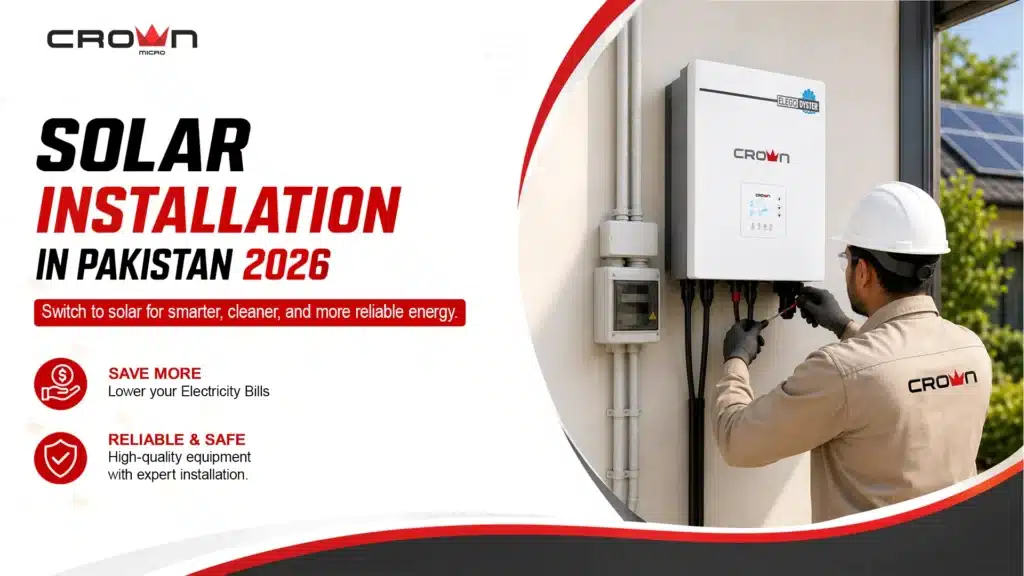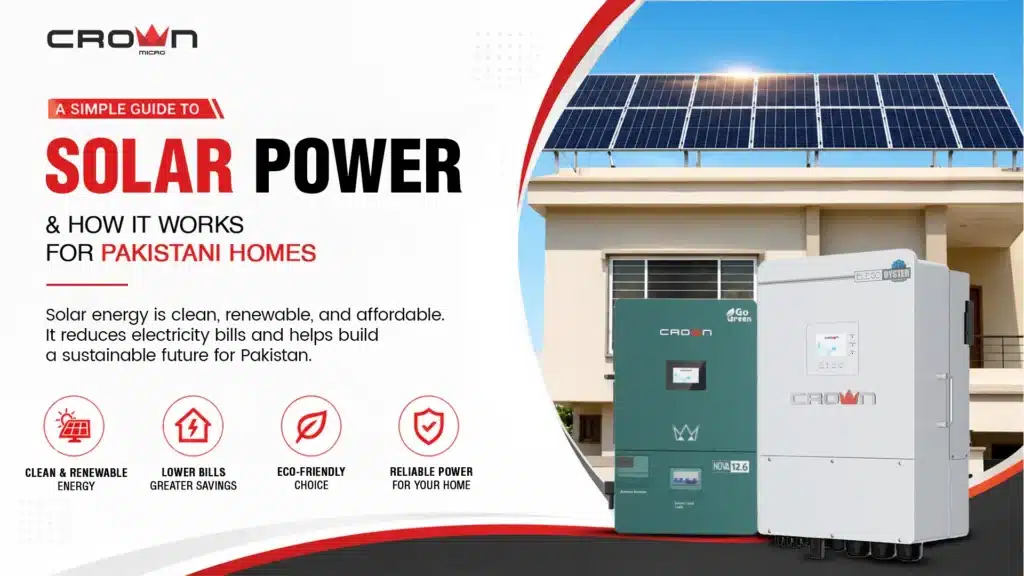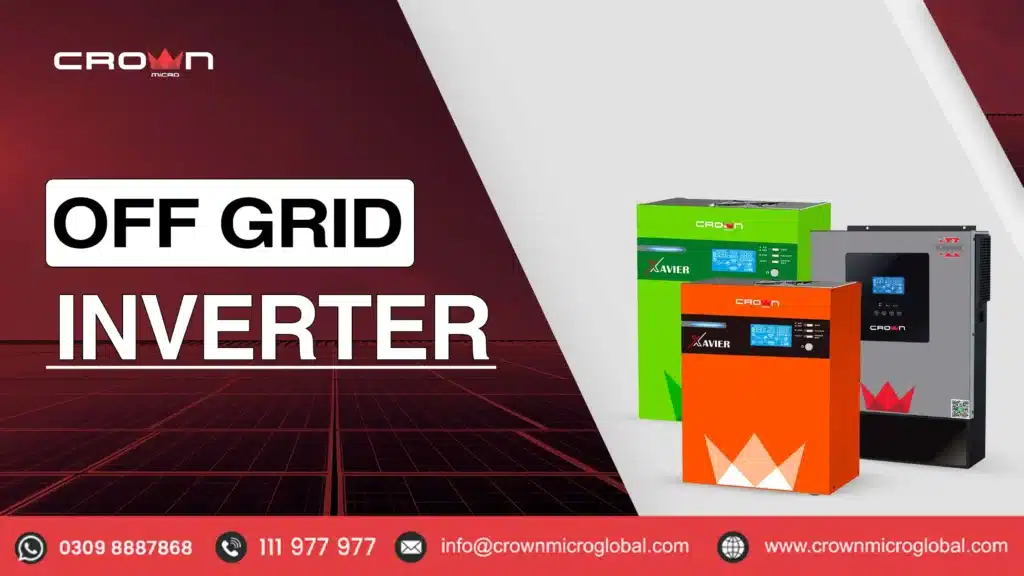
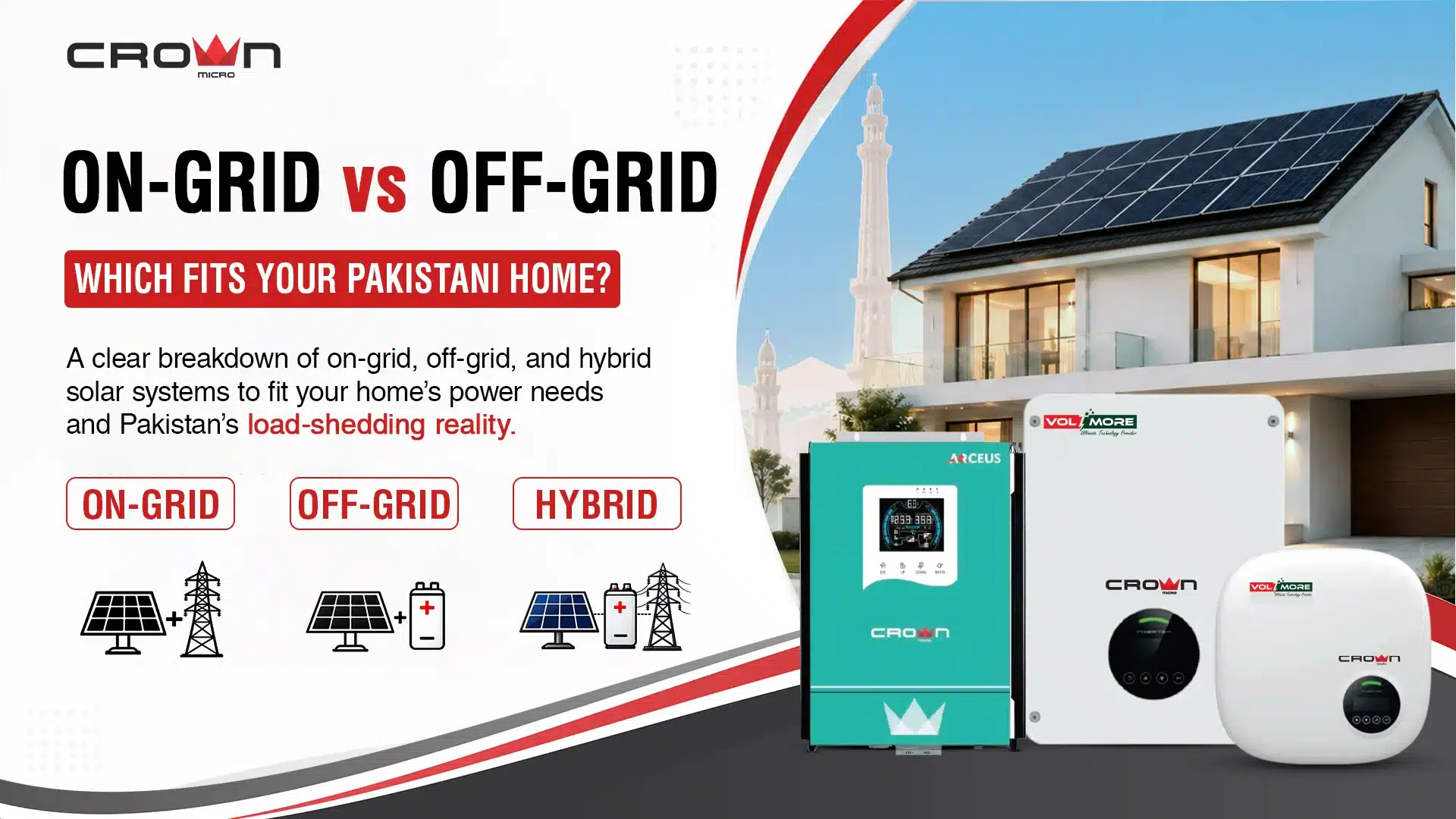
On-grid solar connects to the national grid and works best where the grid is reliable, since it costs less but shuts off during outages unless paired with a battery. Off-grid solar runs independently on batteries and suits areas with frequent load-shedding or no grid access at all. Most Pakistani homes and businesses now land somewhere in between, with hybrid systems that combine both.
Before you decide, here’s what actually separates the three options:
- On-grid systems cost less upfront but offer no backup during a power cut
- Off-grid systems run entirely on batteries and never touch grid electricity
- Hybrid systems switch between grid, battery, and solar automatically
- NEPRA’s 2026 net billing rules changed how much you earn from exporting power
- Off-grid and hybrid setups matter most in areas with long or unpredictable load-shedding
- Battery type and inverter brand affect both cost and how long the system lasts
- The “right” choice depends on your electricity bill pattern, not just your city
Anyone who has sat through a three-hour outage in Lahore’s summer heat knows why this decision matters more than it sounds. It isn’t just about saving money on your bill. It’s about whether your fridge stays cold, your fans keep running, and your business doesn’t lose a day’s work because the grid goes down at the wrong moment.
What Is an On-Grid Solar System and How Does It Work in Pakistan?
An on-grid solar system, powered by a grid-tied on-grid inverter, connects your solar panels directly to the DISCO network. During the day, your panels generate electricity and your home uses it first. Whatever you don’t use gets pushed out to the grid through a bi-directional meter. At night, or whenever your panels aren’t producing enough, you draw power back from the grid as usual.
The appeal is simple. On-grid systems don’t need batteries, which makes them the cheapest way to install solar and the fastest to pay back. There’s less hardware, less maintenance, and a smaller footprint on your roof for the same power output. For homes and businesses in cities where national grid supply is reasonably steady, this used to be the obvious first choice.
Here’s the catch that most guides skip. An on-grid system has no way to store power. If the grid goes down, your solar panels shut off too, even if the sun is blazing overhead. This is a safety requirement, not a design flaw. It prevents your system from sending power into lines that utility workers might be repairing. So if load-shedding is a regular part of your day, an on-grid-only setup leaves you sitting in the dark exactly when you need power most.
How Net Metering Works with On-Grid Solar
Net metering used to be straightforward. You installed panels, connected to the grid, and every unit you exported was credited against every unit you imported at the same rate. Export 300 units in a sunny month and use 400, and you’d only pay for the 100-unit difference. This one-to-one exchange is what made oversized systems attractive for years, since surplus power effectively paid for itself at full retail value.
That math has now shifted. Your export credit and your import cost are no longer treated as equal, which changes how you should size a system from day one. Sizing for your actual daytime consumption matters more now than sizing for maximum export.
Impact of NEPRA’s Net Billing Regulations 2026 on On-Grid Users
In February 2026, NEPRA replaced the old net metering framework with a new net billing system under the Prosumer Regulations, ending the one-to-one exchange of exported and imported units. Under the new rules, distribution companies purchase surplus electricity from solar users at the National Average Energy Purchase Price, a rate well below the retail tariff you pay for imported units, while continuing to charge you the normal consumer tariff for whatever you draw from the grid. The same regulatory notification also reduced the standard agreement term from seven years to five, and it applies to any prosumer generating up to one megawatt, covering homes, small businesses, and industrial connections alike.
There was real pushback. After the change was announced, existing net metering users argued it broke contracts they’d signed under the older framework, and the matter reached the Prime Minister’s office. NEPRA later clarified that consumers with agreements signed under the previous regulations would continue billing under those original terms until their contracts expire, though any major upgrade to an existing system loses that protection and falls under the new rules instead.
Pro Tip: If you already have an on-grid system installed before February 2026, check your DISCO paperwork before adding panels or capacity. Expanding an existing system can strip away the billing protection you currently hold.
What this means practically is that on-grid solar in Pakistan hasn’t stopped making sense. It’s just stopped being a “install as much as you can and sell it back” decision. NEPRA’s new prosumer framework and its shift to a national average purchase price for exported units rewards households that consume most of their own solar power during the day rather than exporting it. A well-sized on-grid system for a household with daytime usage still pays back reasonably fast. An oversized one built for the old rules doesn’t.
What Is an Off-Grid Solar System and Who Needs It in Pakistan?
An off-grid solar inverter, operating as part of an isolated setup, requires no DISCO meter and has no dependence on the national grid at all. Panels charge a battery bank during the day, and that stored power runs your home or business around the clock, day or night, grid outage or not.
This independence comes at a cost. You need enough battery capacity to cover the hours when the sun isn’t shining, which usually means overnight and on cloudy days. That’s a bigger, more expensive system than an on-grid setup of the same panel size, because batteries are the priciest part of any solar installation. You also need to size the system carefully. Underestimate your evening load, and you’ll be rationing power by ten at night.
Still, for the right situation, off-grid isn’t a luxury. It’s the only realistic option.
Best Areas in Pakistan for Off-Grid Solar (Load-Shedding Zones)
Off-grid solar earns its keep in places where the grid either doesn’t reach or doesn’t show up reliably. Rural villages far from a national grid line are the clearest case, along with farmhouses, tubewells, and agricultural operations in Punjab and Sindh’s more remote belts where running new transmission lines simply isn’t practical.
It also matters in areas that technically have a grid connection but suffer from long, unpredictable load-shedding, common in parts of interior Sindh, southern Punjab, and Balochistan. If outages regularly stretch past what a small battery backup can absorb, going fully off-grid removes the guesswork entirely.
Common Mistake: assuming off-grid only applies to villages with zero infrastructure. Plenty of urban and peri-urban areas with unreliable feeders benefit from the same setup, especially small factories running sensitive equipment that can’t tolerate sudden power loss.
What Batteries and Inverters Does an Off-Grid System Need?
Battery choice is where off-grid systems live or die financially. Lead-acid batteries cost less upfront but need more space, more maintenance, and typically last three to five years before performance drops noticeably. Lithium-ion batteries, specifically lithium iron phosphate (LiFePO4) chemistry, cost more initially but handle deep discharge cycles far better and generally last longer under Pakistan’s high summer temperatures, provided they’re installed with proper ventilation and a battery management system.
The inverter matters just as much. An off-grid inverter needs to manage charging from the panels, discharge to your appliances, and battery protection all on its own, without any grid signal to lean on. Pure sine wave inverters are worth the extra cost here, particularly if you’re running sensitive electronics, medical equipment, or industrial motors that don’t tolerate rough power quality.
Did You Know? A properly sized off-grid battery bank is usually calculated to cover two to three days of autonomy, not just one night, to account for stretches of cloudy weather during monsoon season.
What Is a Hybrid Solar System and Is It Better Than Both?
A hybrid solar system, built around an hybrid solar inverter, takes the best of both worlds. It stays connected to power grids like an on-grid system, so you can still benefit from net billing when you have surplus power. But it also includes a battery bank, so when the grid drops, your system switches to stored power instead of shutting down. You get the savings of grid-tied solar and the resilience of battery backup in one setup.
Is it better than both? For most Pakistani households dealing with even moderate load-shedding, yes. You’re not choosing between saving money and staying powered during an outage. You get both, provided you’re willing to pay more for the extra hardware. The short answer is yes, but there’s a catch, and it’s the same one that applies to off-grid: battery cost and battery life determine whether the extra investment actually pays off over time.
How a Hybrid System Handles Load-Shedding and Net Metering Together
A hybrid inverter constantly monitors three inputs: your solar panels, your battery, and the grid. During daylight with good sun, panels power your home directly and top up the battery. Once the battery reaches full charge and your home’s needs are met, any leftover power exports to the grid under NEPRA’s net billing terms. When the grid drops, the inverter switches to battery power automatically, usually within milliseconds, so your appliances barely notice.
This is where hybrid systems earn their reputation. You’re not stuck choosing between “cheap but useless during outages” and “reliable but expensive with no export benefit.” You get a system that adapts to whatever the grid is doing at any given moment.
Why Hybrid Solar Is Becoming Pakistan’s Most Popular Choice in 2026
Two things pushed hybrid systems from a premium option to the default recommendation for most new installations. First, battery prices have come down as lithium-ion technology has matured and more brands entered the Pakistani market, narrowing the price gap between on-grid and hybrid setups. Second, NEPRA’s shift to net billing reduced the financial reward for pure export, which makes storing your own surplus power in a battery for later use, rather than selling it cheaply, a more sensible economic choice than it used to be.
Add Pakistan’s ongoing load-shedding pattern into the mix, and hybrid stops looking like an upgrade and starts looking like common sense for anyone who can afford the difference.
On-Grid vs Off-Grid vs Hybrid Solar: Full Comparison for Pakistani Homes
| Feature | On-Grid | Off-Grid | Hybrid |
| Works during load-shedding | No | Yes | Yes |
| Needs batteries | No | Yes, full capacity | Yes, moderate capacity |
| Upfront cost | Lowest | Highest | Mid to high |
| Net billing eligible | Yes | No | Yes |
| Best for | Stable grid areas | No or unreliable grid | Most Pakistani homes and SMEs |
| Maintenance | Low | Higher (batteries) | Moderate |
| Payback speed | Fastest | Slowest | Moderate |
The table makes the trade-off easier to see, but numbers alone don’t tell you which one fits your situation. That depends on where you live, how bad your load-shedding actually is, and what you’re running on that connection.
Which Solar System Is Right for Your Home in Pakistan?
Best Choice for Urban Homes
If you live in a major city like Lahore, Karachi, or Islamabad with a reasonably stable WAPDA connection and only occasional short outages, on-grid solar still makes financial sense, especially now that NEPRA’s net billing rules reward self-consumption. Households with heavy daytime usage, air conditioners, water pumps, and home offices tend to see the fastest payback because they’re using most of their own solar output rather than exporting it at the lower buyback rate. If even short outages disrupt your routine, adding a modest battery and going hybrid closes that gap without doubling your investment.
Best Choice for Rural or High Load-Shedding Areas
For homes in areas with long, unpredictable outages, or no grid connection within practical reach, off-grid is the more honest answer. It sounds simple until it isn’t: sizing an off-grid system requires an accurate picture of your actual evening and nighttime load, not just a rough guess. Get that sizing wrong, and you’ll either overpay for battery capacity you rarely use or run short of power during a stretch of cloudy days. A proper site assessment before installation saves you from both mistakes.
Best Choice for Small Businesses and SMEs in Pakistan
For clinics, small factories, retail outlets, textile units, and similar SMEs, the calculation usually tips toward hybrid. A few hours without power can mean spoiled inventory, halted machinery, or a full day of lost productivity, and that cost adds up faster than a residential household’s discomfort during an outage. Hybrid systems let a business keep critical equipment running through a load-shedding window while still capturing net billing savings during normal grid hours. For operations running sensitive equipment, water treatment plants, and diagnostic labs, among them, the battery backup isn’t a comfort feature. It’s what keeps the operation from grinding to a halt.
How Much Does Each Solar System Cost in Pakistan?
Solar pricing in Pakistan moves with the rupee-dollar exchange rate and international panel prices, so exact figures shift every few months. That said, some general patterns hold steady enough to plan around.
On-grid systems are the least expensive option for a given capacity, since there’s no battery bank to buy. Off-grid systems typically cost noticeably more than an equivalent on-grid setup, since batteries alone can account for a large share of total project cost, particularly with lithium chemistry. Hybrid systems fall in between, and the exact gap depends heavily on how much battery capacity you choose to include. A smaller battery buffer for short outages costs far less than a full off-grid-equivalent bank.
Common Mistake: comparing quotes purely on price per watt without checking whether the battery, inverter brand, and warranty terms are actually comparable. Two “5kW hybrid” quotes can differ significantly once you look past the headline number.
A few factors move the price more than most buyers expect: panel technology (mono PERC versus higher-efficiency N-type), inverter tier and brand, battery chemistry and capacity, mounting structure complexity on your specific roof, and whether NEPRA net metering or net billing paperwork and equipment are included in the quote. For an accurate figure, a proper site survey and load assessment will always beat any online price chart, since your actual consumption pattern, roof orientation, and shading affect the real cost more than the headline system size does.
What to Look for in a Solar Company for Installation in Pakistan
Choosing a solar installer in Pakistan comes down to a handful of things that actually matter once the panels are on your roof and the warranty period has started. Certification and product quality sit at the top of the list. Look for IEC and RoHS certified panels, and batteries carrying UN38.3 certification, since these aren’t paperwork formalities. They indicate the components have actually passed independent testing rather than relying on the seller’s word.
After-sales support matters just as much as the installation itself. A solar system runs for twenty-five years or more, and a lot can happen in that time, from inverter faults to battery degradation to a monsoon storm damaging your mounting structure. A company with local service centers, rather than an overseas helpline, makes the difference between a same-week repair and weeks of downtime.
This is where Crown Micro Global fits into the picture for a lot of buyers weighing these exact trade-offs. With decades of experience in the power solutions industry and service centers spread across Pakistan, the company handles the full range covered in this article: on-grid, off-grid, and hybrid inverter systems, along with the solar panels, batteries, and UPS units that go with them. What tends to stand out for homeowners and SMEs comparing options is the combination of certified components, a proper site-specific assessment before installation rather than a generic package, and local technical support once the system is running. Whether you’re leaning toward a straightforward on-grid setup in Lahore or a hybrid system for a business that can’t afford downtime, that kind of end-to-end consultation is worth asking about before you commit to a quote.
If your search has led you here, you likely already know that a solar company in Pakistan is more than just a panel supplier. It’s the difference between a system that quietly saves you money for decades and one that leaves you troubleshooting alone after year two.
Frequently Asked Questions About On-Grid vs Off-Grid Solar in Pakistan
Can an on-grid solar system work during load-shedding?
No, not on its own. An on-grid system is designed to shut off automatically when the grid loses power, as a safety measure to protect utility workers repairing the lines. If you need power during outages, you’d need to add a battery and inverter setup that turns your system into a hybrid configuration, or choose off-grid from the start.
Is off-grid solar more expensive than on-grid in Pakistan?
Generally, yes. Off-grid systems need enough battery capacity to cover your full electricity needs around the clock, and batteries are typically the most expensive component in any solar installation. An on-grid system of the same panel capacity, with no batteries required, usually costs noticeably less upfront, though it also can’t provide backup power during an outage.
What happens to my on-grid system after NEPRA net billing 2026?
If your system and net metering agreement were approved before the February 2026 changes, you continue billing under your original contract terms until it expires. New connections, and any existing system that undergoes a major capacity upgrade, fall under the new net billing framework, where exported units are purchased at the national average energy purchase price rather than credited one-to-one against your consumption.
Which inverter is best for hybrid solar in Pakistan?
The right hybrid inverter depends on your load size, budget, and how much battery capacity you plan to run, more than any single “best” brand. Look for a model with proven anti-islanding protection for NEPRA compliance, efficient MPPT charge controllers to maximize panel output even on hazy days, and a track record of handling Pakistan’s grid fluctuations without component failure. A local installer who services what they sell matters as much as the spec sheet.
How long do lithium-ion batteries last in Pakistan’s climate?
Lithium iron phosphate batteries, the most common lithium chemistry used in Pakistani solar installations, are generally rated for several thousand charge cycles under normal conditions, which typically translates to eight to ten years or more of daily use. Pakistan’s high summer temperatures can accelerate degradation if the battery isn’t properly ventilated, so installation quality and battery management systems affect real-world lifespan as much as the battery chemistry itself.
Solar energy in Pakistan has moved beyond early adoption. It’s now a mainstream infrastructure decision for homes, farms, and businesses across the country. Whether you choose on-grid, off-grid, or hybrid depends on where you live, how you use power, and what level of energy security you need.
The market offers more equipment choices than ever. NEPRA’s frameworks are maturing. Battery prices keep falling. What hasn’t changed is the need for proper system design and quality installation. A poorly designed solar system, regardless of type, wastes money and frustrates owners.
Start with an honest assessment of your situation. Log your outages. Map your consumption. Calculate your real budget including lifetime costs, not just upfront quotes. Then choose the architecture that fits your reality, not a sales pitch.
If you’re ready to move from research to action, the next step is a professional site assessment. Your roof angle, shading patterns, and electrical panel capacity all influence system design. Generic online calculators miss these variables. A thorough evaluation transforms solar from a gamble into a calculated investment that pays dividends for decades.
Your energy independence starts with one informed decision. Make it count.